
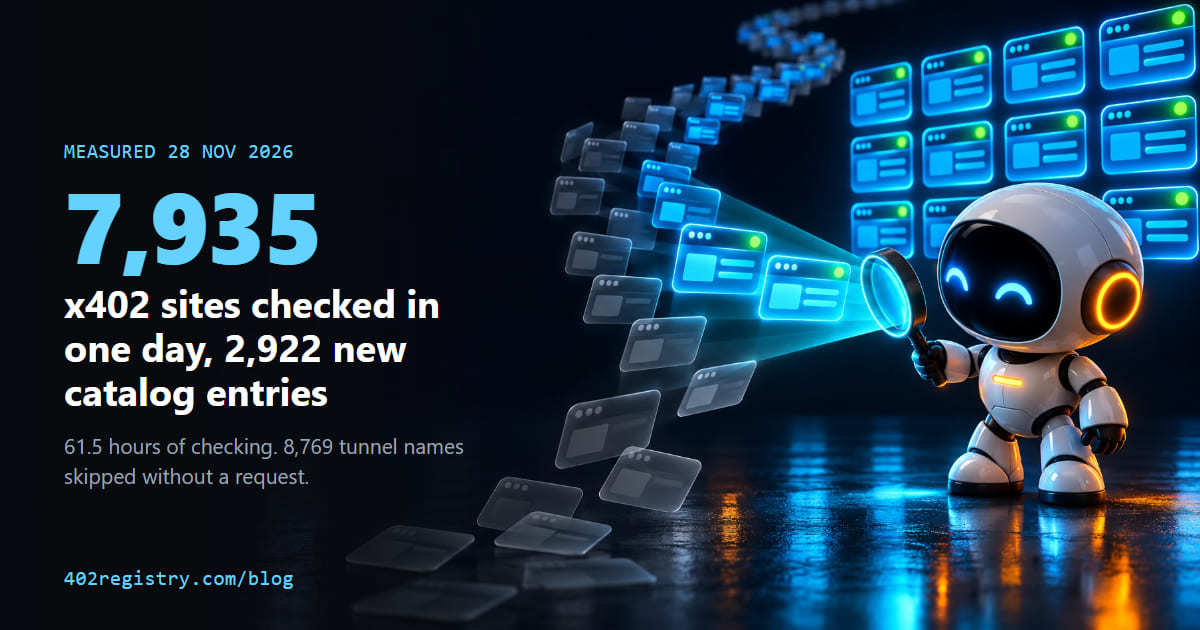
On 28 November 2026 our crawler merged eight public lists of x402 addresses into 23,170 hostnames, set aside 8,769 temporary tunnels without sending them a single request, and ran a full check on the 7,935 sites that had no verdict yet. Added up, those checks took 61.5 hours. 2,922 of the sites (37%) became new entries in our catalog; the other 5,013 did not.
Anyone who wants a list of x402 services that an agent can actually call starts from the same pile. Public lists are long, they overlap, and they keep names that no longer answer. This report counts what one day of turning that pile into catalog entries took, and how much of the work ended in the bin.
What we measured
- The lists. Four public directories of x402 services, the x402 Bazaar among them; x402scan, split into entries updated in the last month and older ones; the homepage addresses of GitHub repositories and npm packages about x402; and hostnames containing “x402” from the Common Crawl index. Merged, with repeats removed, they came to 23,170 hostnames.
- Skipped without a request. 8,769 of those hostnames (38%) were temporary tunnels: addresses that forward to someone’s own computer for as long as a session lasts. They are recognised by name and never fetched. Names that already had a verdict from an earlier day were not checked again. Two rules about owners held back some more: a limit on free entries per owner, and a stop for owners whose earlier sites had all failed.
- The check. The free form of the check behind every catalog entry. Plain HTTP from a single
ordinary internet connection, with no browser and no JavaScript, under a user agent that says it is a bot.
robots.txtis read first. At most 21 requests per site, never more than one per second to the same site, 12 sites at a time. - Rules first, then a model. Fixed rules refuse a site that gives no answer, shows nothing, sends visitors somewhere else, or looks parked or spammy. Only a site that gets past them goes to a language model, which writes the one-line description and can still decide that there is too little to describe, or that the page is spam.
- The catalog’s last word. A passing report is declined when a site already listed shows the same visible text. The listed site keeps its entry.
- The record. For every check the crawler logs the verdict, its reason, the requests and the seconds it took; the catalog’s answer comes from the crawler’s own state. The rows, with every hostname removed, are kept with our other measurements.
What came back
Each of the 7,935 checks ended in exactly one of these outcomes:
| Outcome | Sites |
|---|---|
| Passed the rules and the model | 3,085 |
| No answer at all: the name did not resolve, or the connection failed or timed out | 1,303 |
The front page answered with a status other than 200, such as a 404, a server error or a payment request | 2,038 |
| The front page answered with almost nothing to read: hardly any text, no title of its own, no description, no structured data | 882 |
| The model found too little on the page to describe | 380 |
| The front page sends visitors to a different site | 88 |
| A parked domain | 57 |
| The model judged the page to be spam | 53 |
| A page of links to other sites with almost no text of its own | 40 |
Other: flagged by a security resolver, a robots.txt that shuts out search engines, commercial spam words | 9 |
| All checks | 7,935 |
Of the 3,085 that passed, 2,922 became new entries. 150 more carried the same visible text as a site already listed and were declined, and 13 were in the catalog already. So 37% of the sites checked turned into new entries, about one for every 2.7 checked.
Most of the losses happen at the front door. 4,223 of the checked sites (53%) gave no answer, answered with an error, or served a page with nothing on it. In September, counting front pages across the x402 Bazaar alone, we found that about half of all hosts had no front page a crawler can read. The method differs, but the share here is about the same.
Where the time and the requests went
Added up site by site, the 7,935 checks took 61.5 hours, each counted from its first request to its verdict, with the one-second spacing between requests and the wait for the model included. Run 12 at a time, they took 5 hours and 21 minutes of wall time, from the moment the merged list was ready to the last verdict.
A site that fails is cheaper to check than one that passes: a front page that never answers ends the check early, and a site a rule has refused is never shown to the model. Even so, 45% of the checking time and 57% of the requests went to sites that did not become new entries. A language model read 3,518 pages (44%); for the other 4,417, a rule had settled the matter before any model was asked.
The requests need one note. The check books its budget before it fetches: six places for the front page, enough for five redirects, and two each for the plain http address and the www or bare form of the name, whether the redirects happen or not. By that count the run made 127,375 requests. That is an upper bound: fewer really left the machine, and the log does not say how many fewer.
Per new entry, that is 2.7 sites checked, about 76 seconds
of checking and up to 44 requests. Two groups never reached a verdict and are not in these
figures. 128 sites have a robots.txt that closes the whole site to every crawler, so the check read
that file and stopped. For 23 sites, the security lookup that runs before every fetch failed on all four
tries, and they were never checked.
What the two catalog files hold
When the checks began, the free catalog file listed 3,821 sites; later that day it listed 6,723. Every one of them passed a check of this kind, on 28 November or earlier.
The free file gives, for each site, its address and owner, category and topic, a one-sentence description, score and band, the number of public findings, and the dates it was listed and last judged. It is open to anyone: every page of our site links to it at the bottom, and the catalog page shows the same list to people.
The paid snapshot, which agents fetch from /buy/catalog, is the same list with the record of the check behind
each entry: every public finding with its rule and severity, the hosting and framework we detected, the page title, the rules
version, and what a reader that runs no JavaScript saw. That last part covers how much visible text the page had and how it
begins, its meta description and structured data types, the status of the front page, the codes AI crawler user agents got
next to our own request, and what robots.txt, the sitemap and llms.txt returned. Each record also
carries the request count and the duration of its check, the two figures this report adds up. Findings that would help an
attacker, an exposed key for example, are left out of both files.
That makes the comparison concrete. To rebuild the record for the sites added on this one day, a reader would merge the same eight lists, drop 8,769 tunnels, check 7,935 sites at a polite pace, spend 61.5 hours of checking time and up to 127,375 requests, ask a language model about 3,518 pages, and keep 2,922 of the results. The other entries in the files come from earlier days, which this report does not measure.
Caveats
One day, one connection. Every figure comes from a single run on 28 November 2026, from one ordinary internet connection. A site that gave us no answer may answer from somewhere else, or an hour later; we did not check the failures again from a second network. Security software on the machine that runs the crawler has blocked a few sites on other days, and those then look like sites with no answer. Its log shows no block during this run.
Other people’s lists. What the lists hold decides most of the outcome: a cleaner list would give a higher share of entries, a messier one a lower share. Most of the tunnel names sat among older entries, so the tunnel count says little about services listed recently.
A model decides part of it. For 3,518 sites the last word came from a language model, and it turned away 433 of them. Another model, or the same one on another day, could draw that line elsewhere.
Duplicates are exact. Two sites count as one only when their visible text is long enough to compare and matches once case and spacing are ignored. Near copies stay as separate entries.
What the counts leave out. The requests are the ones booked for the checked sites; fetching the lists,
the security lookups and the questions to the model are not among them. The 128 sites stopped by
robots.txt and the 23 never checked are outside the 7,935. Times are rounded to whole
seconds per site.
The catalog moves. Between the start of the checks and that afternoon the free file grew by 2,902 sites, 20 fewer than the new entries. Sites also leave the catalog, for instance when a later re-check refuses them, and we did not trace which ones left that day.